Hurricane Safety and Preparedness
Hurricane Milton is one of only a few Category 5 storms in the Atlantic Basin.
Overview While Category 5 storms are the most extreme of Atlantic hurricanes, they are fairly uncommon.
This last occurred in September 2022 and 2023 with Ian, then Lee, prior to Milton and Beryl this season.
.jpeg)
In September, they typically take place either in the Gulf of Mexico or the Caribbean Sea.
Hurricane Milton put its name on the rare list of Atlantic Basin Category 5 hurricanes Monday, joining Beryl from earlier this season.
Category 5 hurricanes occupy the most elite status in the Atlantic Basin. One hundred years of history has shown they have preferred locations and times of year, but there are also outliers, especially in recent years.
Milton and Beryl are the latest members: Milton became a Category 5 at 11:55 a.m. EDT Monday, joining Michael from 2018 as only the second Gulf of Mexico hurricane to hit this intensity in October since satellite detection of storms began in 1966, according to Dr. Phil Klotzbach, a tropical scientist at Colorado State University.

Earlier this season, Beryl became the record-earliest Category 5 in any Atlantic hurricane season on the evening of July 1, 2024. Beryl leapfrogged 2005's Hurricane Emily - the previous earliest Cat. 5 - by a whopping 15 days. That was just one of the many early-season records Beryl shattered.
A hurricane can only be rated as a Category 5: On the Saffir-Simpson Hurricane Wind Scale, a hurricane must have maximum sustained winds of 157 mph or higher to reach this intensity. That is equivalent to the estimated winds of an EF3 or stronger tornado, if you are more familiar with the EF scale for tornadoes.
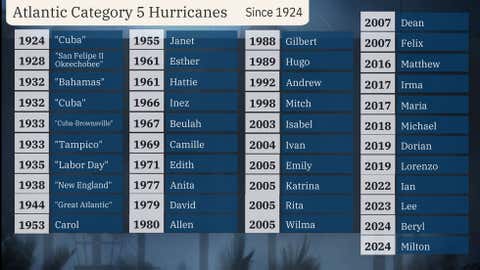
According to the historical database maintained by NOAA, there had only been 40 such Cat 5 hurricanes in the Atlantic Basin since 1924 before Milton and Beryl.
.jpeg)
A season with two Category 5 storms is even rarer: According to a post that Klotzbach made on X, since 1950, there have only been five seasons in the Atlantic Basin that have produced two or more Category 5 hurricanes. The most recent of these years was 2019, when Dorian and Lorenzo reached that strength. 2005 had the most, with Emily, Katrina, Rita, and Wilma being the four.
Since 2016, there have been ten hurricanes of Category 5 in the Atlantic: This most recent string of Category 5 hurricanes in the Atlantic includes, in addition to Milton and Beryl, Lee in 2023, Ian in 2022, Dorian and Lorenzo in 2019, Michael in 2018, Maria and Irma in 2017, and Matthew in 2016.
From 2016 to 2019, a four-year streak of at least one Category 5 hurricane was the longest on record.
.jpeg)
The list of Category 5 hurricanes that hit the Atlantic Basin from 1924 to early October 2024.
(Data: NOAA) There have also been prolonged "droughts": Prior to Matthew in 2016, the Atlantic went eight seasons without a Category 5 hurricane. Between the hurricanes Allen and Gilbert, an additional eight years passed, from 1980 to 1988.
During the height of hurricane season, they are most prevalent: By far, Category 5 hurricanes have occurred most frequently in September. However, they have also occurred at least twice per month in August and October.
.
There have been long "droughts" as well: Prior to 2016's Matthew, the Atlantic went eight consecutive hurricane seasons without a Category 5. There was another eight-year stretch between hurricanes Allen and Gilbert, from 1980 to 1988.
They are most common in the peak of hurricane season: September is when Category 5 hurricanes have occurred most often, by far. But they have also happened at least a half dozen times each in August and October.
This encompasses the most active period of hurricane season. That's because all of the favorable conditions and ingredients for development are most likely to overlap over a large area of the Atlantic Basin.
As mentioned earlier, Hurricane Beryl was the earliest Category 5 on record (July 1-2). The Cuba hurricane of 1932 was the latest Category 5 and the only one in November (Nov. 5-8).
Here's where in the Atlantic they have most commonly formed: The map below shows, in red segments, the locations where hurricanes have reached Category 5 intensity, including Hurricane Beryl early this season.
Other than the oddity that was 2019's Hurricane Lorenzo in the far eastern Atlantic, you'll notice almost all of them happen in the same general area, from the southwest Atlantic Ocean north of the Lesser Antilles into the Caribbean Sea and Gulf of Mexico.
You'll notice that almost all of them occur in the same general area, from the southwest Atlantic Ocean north of the Lesser Antilles into the Caribbean Sea and Gulf of Mexico, with the exception of the peculiar 2019 hurricane Lorenzo in the far eastern Atlantic.
These regions provide a supply of deep, warm ocean water, do not experience hostile shearing winds during hurricane season, and feature a series of disturbances known as tropical waves that serve as development seeds. The Atlantic Basin, particularly the Caribbean Sea, contains the greatest supply of warm, deep ocean water that fuels hurricanes.
From 1924 to Hurricane Beryl in early July 2024, 41 hurricanes in the Atlantic Basin reached Category 5 status. Their tracks can be seen above. the parts of the tracks where each hurricane was a Cat during that time. 5 is shown by the red portions.
(Data: NOAA/NHC) Hurricanes with Category 5 intensity don't last long: A hurricane typically stays in Category 5 status for just under 24 hours on average.
This is due to the fact that intense hurricanes typically undergo one or more cycles of eyewall replacement. A new outer ring surrounds the hurricane's intense thunderstorm ring around its eye during one of these.
As the previous eyewall is choked off, this causes the hurricane's wind intensity to temporarily decrease. When the new outer eyewall is pulled inward, it typically intensifies once more, resulting in a larger hurricane.
During their lifetimes, a number of Category 5 hurricanes experienced multiple instances of that intensity.
H urricanes Allen (1980), Isabel (2003) and Ivan (2004) each took off to Class 5 force three separate times in their excursions.
According to the database maintained by NOAA, the hurricanes that struck Cuba in November 1932 (78 hours) and Hurricane Irma in 2007 (77 hours) lasted the longest at Category 5 strength.
At Category 5 intensity, only four hurricanes have ever made landfall in the mainland United States: The most recent of these was Hurricane Michael in October 2018, which hit the Florida Panhandle.
Other hurricanes include Camille in 1969 on the Mississippi Gulf Coast, Andrew in 1992, and the 1935 Labor Day hurricane in the Florida Keys.
In 2022, hurricane Ian almost did that, but when it made landfall, it was still a Category 4 hurricane.
After beginning his career with The Weather Channel in the early 2000s, Chris Dolce has been a senior meteorologist at weather.com for more than ten years.
Since a tornado narrowly missed his childhood home in Wisconsin when Jonathan Erdman was 7 years old, he has been an incurable weather nerd. He is a senior meteorologist at weather.com. Connect with him on Facebook, X (formerly Twitter), and Threads.


Comments
Post a Comment